
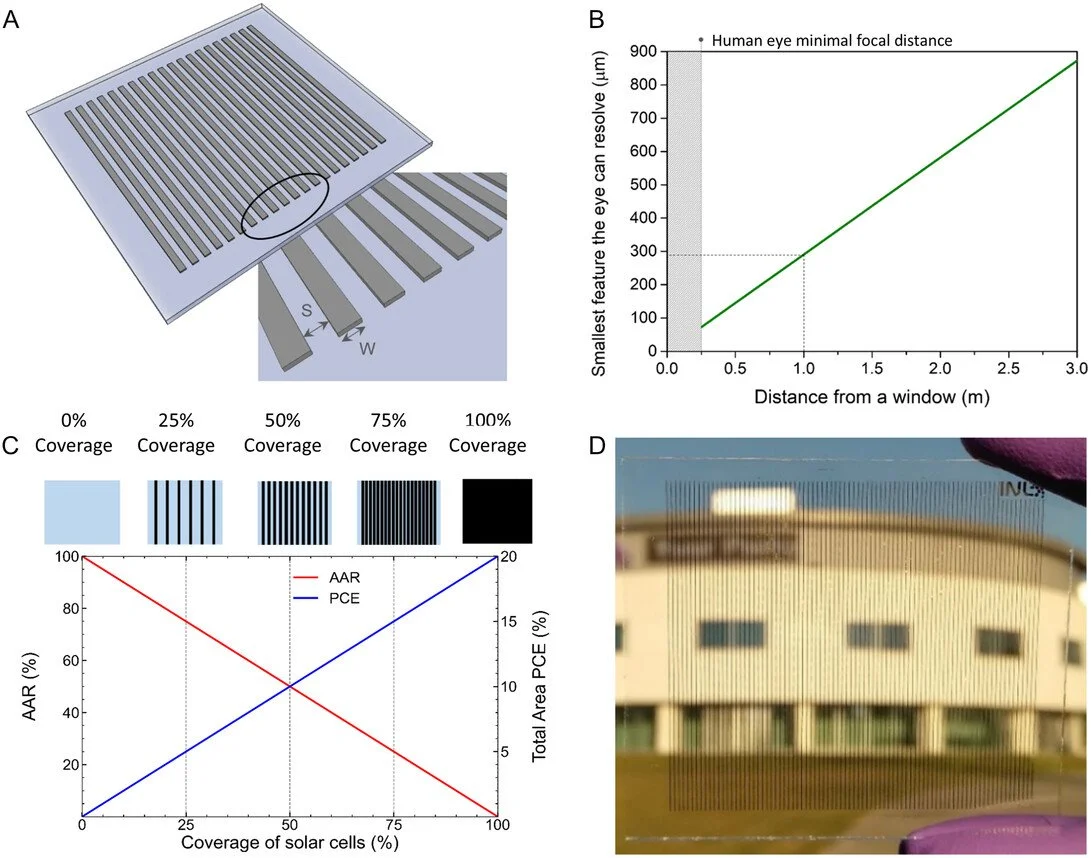
The Hi-BITS consortium is proud to announce a new publication in the journal RRL Solar, investigating spatial segmentation as a technique to preserve full absorber thickness and visual neutrality in thin-film solar cells.
The study also explores scalability potential by testing performance on a semi-transparent mini-module. Results demonstrate a 40% average visible transmittance and a 10.9% active-area efficiency, yielding a light-utilisation efficiency of 2.2%; all while retaining a colour-neutral appearance in a semi-transparent mini-module with series interconnection along the segmented stripes.
🔗 Read the full publication: https://doi.org/10.1002/solr.70347
Why Spacial Segmentation Matters
Conventional approaches to light transmission in thin-film solar cells often require reducing absorber thickness, which compromises efficiency. Spatial segmentation offers a fundamentally different route. By integrating experimentally validated segmentation geometry into scalable device architectures, the study shows that:
Preserving full absorber thickness maintains photovoltaic performance while enabling meaningful light transmission
A 40% average visible transmittance can be achieved without sacrificing colour neutrality, meeting key visual comfort requirements for building integration
Series interconnection along segmented stripes is compatible with mini-module upscaling, confirming practical scalability
Spatial segmentation provides a viable path to meeting AVT, CRI, and visual comfort requirements for façade-integrated STPV
Relevance for Ongoing CIGS Research
This work supports ongoing efforts to develop semi-transparent thin-film photovoltaics suitable for building-integrated applications. The results demonstrate that spatial segmentation is not only effective at the single-cell level but also scalable, as confirmed by mini-module fabrication. The methodology and performance metrics presented are relevant for researchers working on STPV technologies, particularly those targeting aesthetic and visual comfort requirements for façade integration.
Open Access
In line with open science practices, the publication and all associated data are openly available on Wiley, enabling reproducibility and further exploration by the research community.
🔗 Access the article: