
New Publication “Colour-neutral photovoltaic windows with performance linearly tuneable with transmittance”
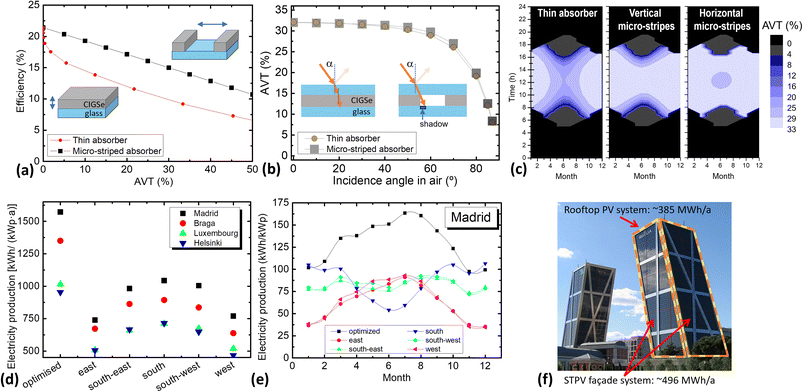
The Hi-Bits project presents a new publication in the journal EES Solar, exploring interdigitated micro-stripes of chalcogenide solar cells and bare glass as an approach to achieving superior optical and electrical performance in next-generation semi-transparent photovoltaic (STPV) technologies.
The study compares micro-stripe geometry with ultra-thin absorber approaches, evaluating both as energy generators and daylight-transmitting windows across daily and seasonal cycles.
🔗 Read the full publication: https://pubs.rsc.org/en/content/articlelanding/2026/el/d5el00187k
Why Interdigitated Micro-Stripes Matter
Modern architecture increasingly relies on glass façades, yet this vast surface area remains largely untapped for energy generation. The challenge lies in developing STPV technologies that simultaneously meet the optical and electrical requirements for real-world building integration. By interdigitating micro-stripes of chalcogenide solar cells with bare glass, this approach addresses all three key requirements at once:
AVT ranging from 30 to 70% is demonstrated, covering the full practical range for architectural glazing applications
A record power conversion efficiency of 2.5% is achieved at a high AVT of 64%, alongside an excellent 5.8% efficiency at 34% AVT, both with a colour rendering index exceeding 99
Relevance for Ongoing CIGS Research
While opaque rooftop installations remain the standard for solar panels, glass building facades present a compelling opportunity to optimise on-site energy generation. Realising this potential requires overcoming the key challenges of STPV: meeting requirements for average visual transmittance (AVT), spectral quality (expressed as colour rendering index, CRI), and visual comfort. Micro-striped Cu(In,Ga)Se₂ STPV offer a promising alternative approach for building-integrated photovoltaics.
Open Access
In line with open science practices, the publication and all associated data are openly available on Wiley, enabling reproducibility and further exploration by the research community.
🔗 Access the article:
https://doi.org/10.1039/D5EL00187K
See how we shared this update on social media: LinkedIn, Instagram