
New publication: "Reducing VOC losses in bifacial (Ag,Cu)(In,Ga)Se2 solar cells"
The Hi-BITS consortium is proud to share its new publication "Reducing VOC losses in bifacial (Ag,Cu)(In,Ga)Se2 solar cells". Featured in the journal Solar Energy Materials and Solar Cells, the piece investigates the origin of open-circuit voltage (VOC) losses in bifacial CIGS solar cells compared to their counterparts on traditional opaque back contacts.
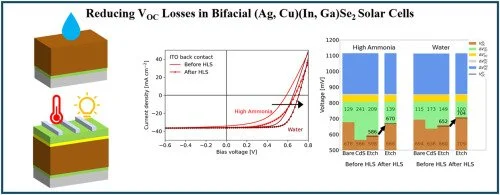
The study reveals that these losses are strongly linked to the absorber rinsing step performed prior to buffer layer deposition, with ammonia-based rinsing solutions found to introduce substantial non-radiative recombination at the absorber/buffer interface. By replacing the rinsing solution with DI water, and applying a subsequent heat-light soaking treatment, the team was able to partly mitigate these losses, with voltage levels approaching the initial potential of the bare absorbers.
🔗 Read the full publication: https://doi.org/10.1016/j.solmat.2026.114547
Why the Rinsing Step Matters
Bifacial CIGS solar cells hold strong potential for applications requiring higher yearly energy yield, thanks to their ability to convert stray light reflected from the ground. However, replacing the traditional opaque molybdenum back contact with a transparent alternative has historically come with a performance penalty. By identifying and addressing a previously overlooked processing step, the study shows that:
The absorber/buffer interface in bifacial architectures is significantly more sensitive to rinsing chemistry than in cells grown on standard Mo back contacts
Ammonia-based rinsing introduces substantial voltage losses, as confirmed through photoluminescence quantum yield (PLQY) and radiative voltage loss analysis
Switching to a DI water rinse, combined with heat-light soaking treatments, recovers much of the lost voltage
These process refinements enable a bifacial solar cell with an in-house front-illumination efficiency of 19.9%, alongside improved back-contact transparency compared to the current state of the art with similar performance
Relevance for Ongoing CIGS Research
This work supports ongoing efforts to close the performance gap between bifacial and conventional CIGS solar cells. By pinpointing a specific, correctable source of voltage loss, the study offers a practical processing pathway for researchers and manufacturers working to scale up transparent back-contact architectures without compromising efficiency.
Open Access
In line with open science practices, the publication is openly available, enabling reproducibility and further exploration by the research community.
🔗 Access the article: https://doi.org/10.1016/j.solmat.2026.114547