
Inside Hi-BITS testing sites: An interview with Maxim Guc
Hi-BITS' mission centres on developing next-generation solar technology capable of achieving a record 25% power conversion efficiency.
To that end, Work Package 6, Device/Module Real-Life Characterisation for Relibility and Energy Yield Assessment, proves itself imperative, by testing these innovative prototypes at different European locations.
In this interview, Maxim Guc from IREC, working on WP6, walks us through the reasoning behind the testing site locations, along with early results and degradation mechanisms observed so far.
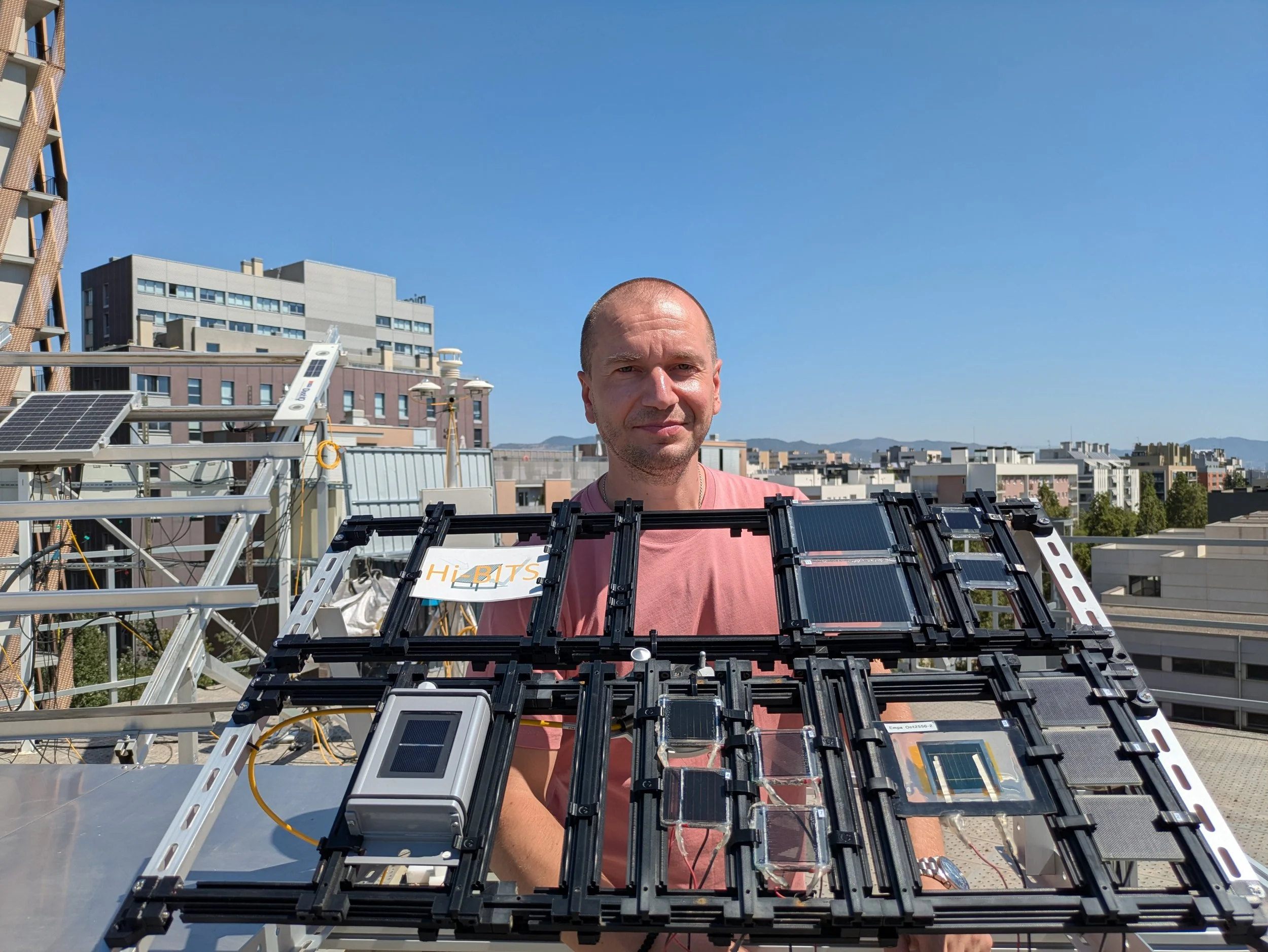
Maxim Guc with mounted modules
Q: What is the main role of WP6 within the Hi-BITS project, and how does it contribute to the project’s overall objectives?
Maxim: The main role of WP6 is to evaluate the long-term outdoor performance of the photovoltaic modules developed within the Hi-BITS project under real operating conditions. To achieve this, the modules are installed at several test sites representing different European climates and application scenarios.
This allows us to verify that the innovative materials and device architectures developed in other work packages maintain their performance and reliability outside the laboratory. Finally, WP6 provides the evidence needed to demonstrate that the new Hi-BITS technologies are stable, durable, and suitable for a wide range of real-world photovoltaic applications.
Q: Hi-BITS fully functionalised and encapsulated prototypes are currently undergoing real-world testing. Which European sites were selected, and what were the key criteria behind their choice?
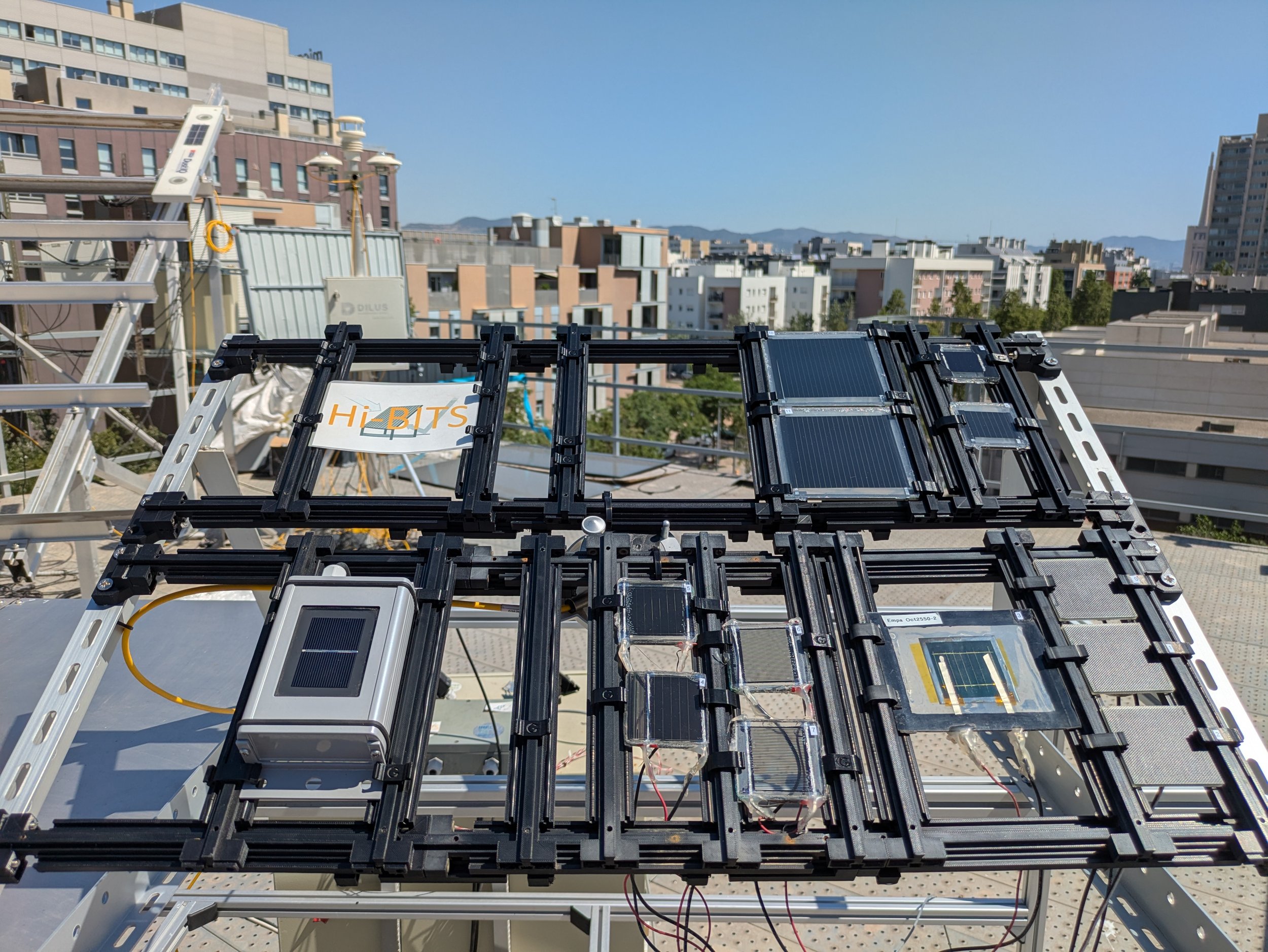
Maxim: The project includes four outdoor test sites located across Europe: Barcelona (Spain) at the IREC facilities, Uppsala (Sweden) at Uppsala University, the Paris region (France) near IPVF, and southern Germany at the ZSW facilities. These locations were selected to represent typical European climate conditions, with the Mediterranean climate of Barcelona, the temperate continental climates of central France and south of Germany, and the colder Nordic climate of Sweden. In addition, the sites represent different installation environments. Some are located in urban areas, where modules are exposed to partial shading and higher levels of pollution, while others are in rural locations with excellent solar exposure and lower soiling. This diversity allows us to evaluate the behaviour of the modules under realistic operating conditions across a wide variety of environments.
Q: Do you apply any international standards to perform outdoor monitoring?
Maxim: Yes. We designed our monitoring methodology based on internationally recognised IEC standards for photovoltaic performance monitoring. However, because Hi-BITS focuses on advanced thin-film photovoltaic technologies, we expanded the standard procedures to obtain more detailed scientific information. In particular, we incorporated regular current-voltage measurements, which provide valuable insight into possible degradation mechanisms that cannot be detected by monitoring only the maximum power output. We also developed a common monitoring protocol covering module pre-characterisation, installation procedures, selection of suitable commercial reference modules, and the environmental and electrical parameters to be recorded. Applying the same protocol at all four test sites ensures that the results are directly comparable and scientifically robust.
Q: Based on the results so far, have you observed any notable differences in performance across various climates or application scenarios, such as solar plants, BIPV, and Agri-PV?
Maxim: Based on the results obtained so far, we have not observed any significant dependence of module performance on the different climate zones. This is a very encouraging outcome, as it suggests that the new module designs perform consistently under a wide range of environmental conditions. As expected, application-specific factors such as partial shading or non-optimal orientation, common in BIPV, do affect the overall energy yield. However, these effects are comparable to those observed in commercial reference modules operating under the same conditions. This indicates that the Hi-BITS modules are well suited for a broad range of photovoltaic applications, including conventional solar plants, BIPV, and potentially Agri-PV systems.
Q: Drawing on your expertise, what do you anticipate will be the main degradation mechanisms affecting the modules under real-world operating conditions?
Maxim: One of the key innovations developed in Hi-BITS is the introduction of new back-contact architectures, including transparent back contacts and highly reflective back layers (or back reflectors). These modifications have the potential to improve device performance, but they also require careful optimisation of the complete solar cell structure and manufacturing process.
Initially, we expected these novel back-contact materials to represent the most critical components under long-term outdoor operation. Their optical and electrical properties could potentially degrade over time due to diffusion processes, environmental exposure, or prolonged operation under varying temperatures.
However, after approximately nine months of outdoor testing, we have not observed any significant performance losses in the first generation of Hi-BITS modules. In fact, some devices have shown a slight improvement in performance over time. Although these results still need to be confirmed through continued monitoring and detailed laboratory analysis, they are very encouraging and suggest that the new device architectures are performing even better than initially expected.