
A new publication from the Hi-BITS consortium was recently published on the journal Progress in Photovoltaics: Research and Applications.
Titled “High-Mobility and Low Carrier Concentration Transparent Conducting Oxide Rear Contact for Bifacial CIGS Solar Cells”, the article investigates how transparent conducting oxides (TCOs) can be optimized as rear contacts to improve the performance of bifacial CIGS solar cells under rear illumination.
Bifacial CIGS solar cells, capable of harvesting light from both the front and rear sides, currently suffer from low short-circuit current density (Jsc) when illuminated from the back. This study explores whether high-mobility, low carrier concentration TCOs can serve as transparent back contacts (TBCs) to overcome this limitation.
🔗 Read the full publication: https://doi.org/10.1002/pip.70061
Optimizing Transparent Back Contacts for Rear Illumination
The study combines optical simulations with experimental device fabrication to identify and validate TCO properties that improve rear-side performance:
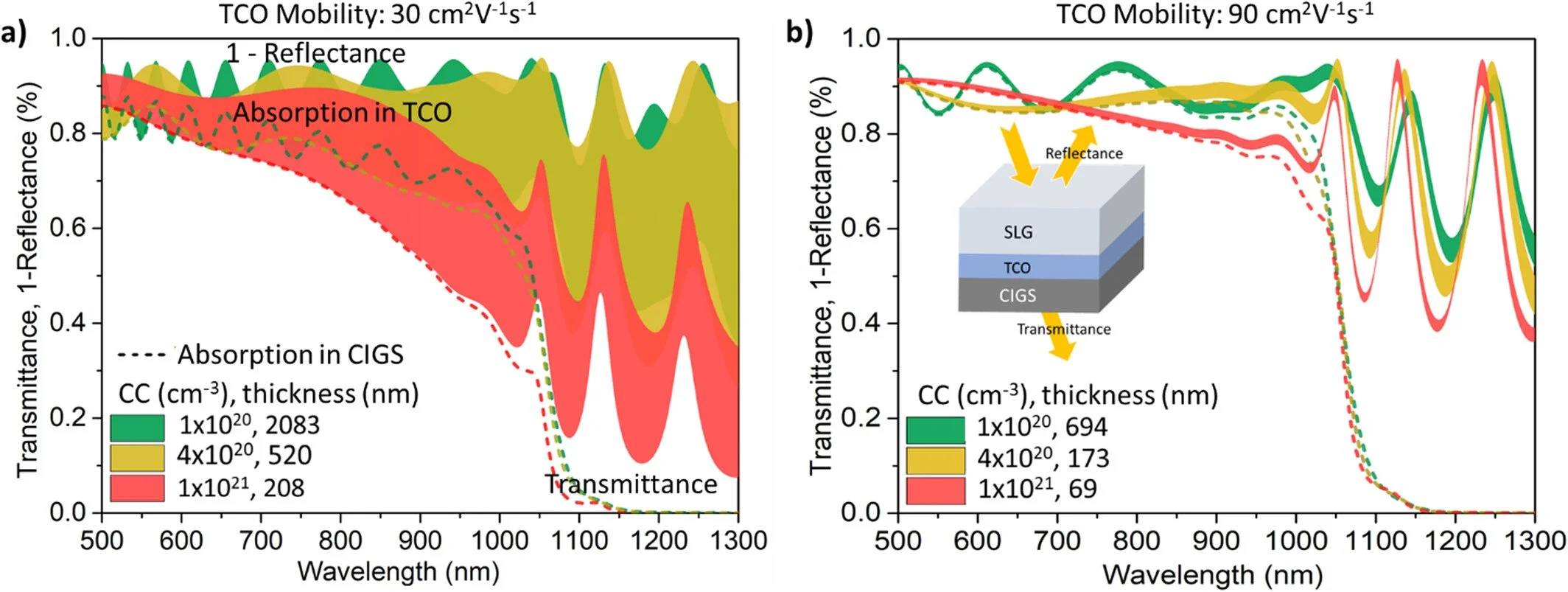
Optical simulations show that TCOs with high carrier mobility and low carrier concentration reduce parasitic absorption and improve light coupling into the CIGS absorber, respectively.
Building on these simulations, the team fabricated CIGS solar cells using In₂O₃:Sn (ITO), In₂O₃:H (IOH), and In₂O₃:Zr (InZrO) as transparent back contacts.
IOH and InZrO outperformed ITO, raising the rear external quantum efficiency maximum from around 50% to above 80% — a substantial improvement in how effectively rear-side light is converted into current.
IOH and InZrO also retained their optical transparency after the CIGS growth process significantly better than ITO, making them more robust choices for device integration.
The poor rear EQE observed at short wavelengths was attributed to strong recombination at the rear interface, pointing to an area for further improvement.
Implications for Future Bifacial Device Design
Beyond the experimental results, the study provides a forward-looking analysis of realistically achievable Jsc gains under rear illumination when combining these improved TBCs with a steeper gallium gradient at the rear interface and a passivated rear contact. This roadmap offers concrete guidance for the next generation of high-performance bifacial CIGS devices, addressing both material selection and interface engineering.
Open Access Publication
In line with open science practices, the publication is openly available, enabling reproducibility and further exploration by the research community.
🔗 Access the article: https://zenodo.org/records/19062667