
Hi-BITS aims to transform the thin-film solar industry by achieving 25% power conversion efficiency. Reaching this goal, however, requires minimising efficiency losses in the transition from individual solar cells to full modules.
Work Package 4 (WP4) plays an important role by focusing on reducing cell-to-module efficiency losses, and ensuring quality control through process monitoring.
In this interview, Marika Edoff, Professor in Solid State Electronics at Uppsala University and WP4 leader, explains the challenges involved and the techniques being developed to address them.
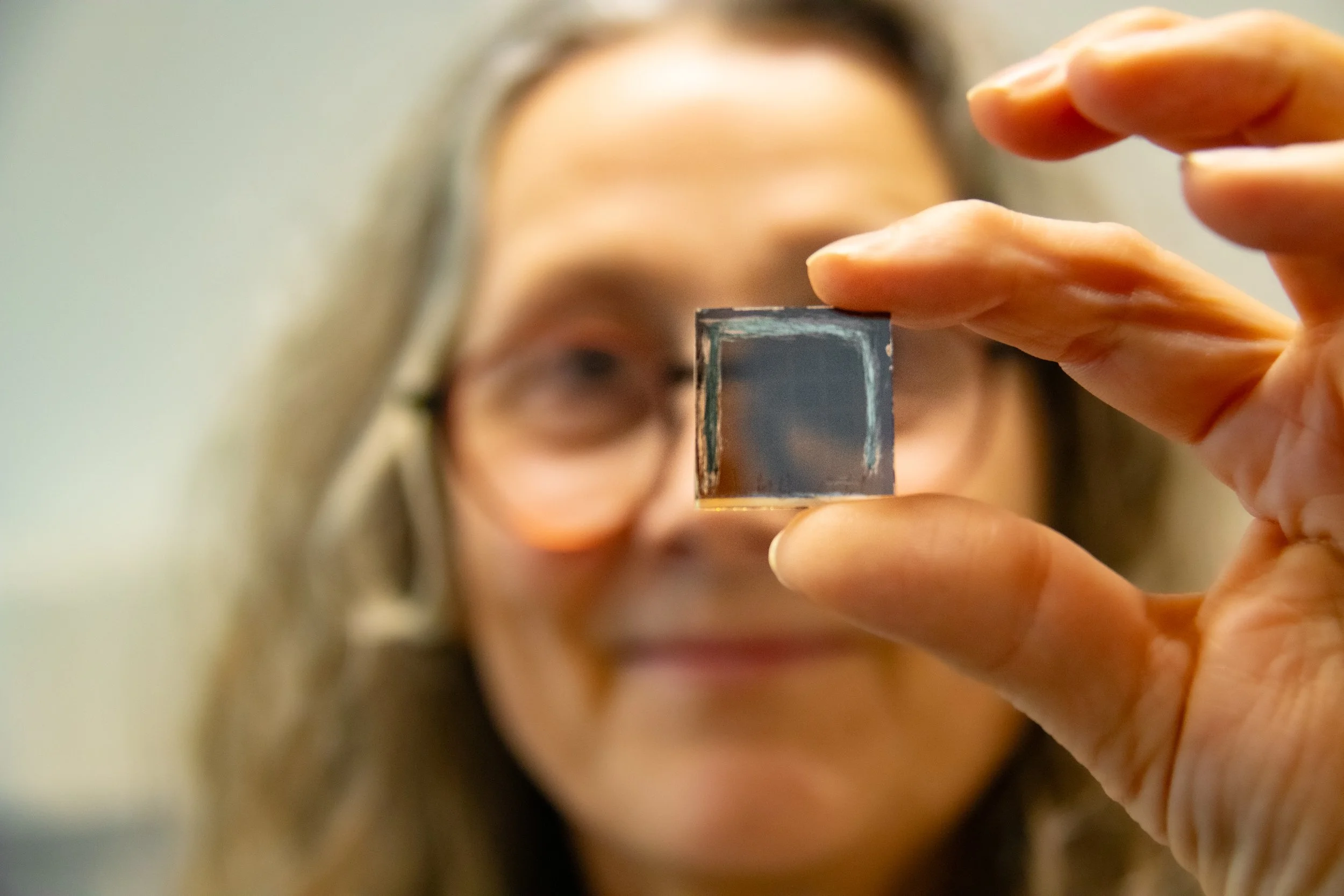
Marika Edoff, Professor in Solid State Electronics at Uppsala University
Scaling Up: The Challenges of Module Production
Q: One of Hi-BITS' core challenges is reducing the gap between record solar cell efficiencies and real-world module performance. How is WP4 tackling this challenge, and why is it crucial for the project’s impact?
Marika: Making modules introduces several challenges compared to cells. With molybdenum-based back contacts, a naturally formed molybdenum selenide lubricant allows mechanical scribing of the CIGS layer. With transparent conducting oxide (TCO) back contacts, gallium oxide forms instead — a material with different mechanical properties — making alternative interconnect solutions necessary.
Uniformity over large surfaces is another challenge. For instance, if the bandgap changes across the surface, the module cells may deliver the same efficiency, while presenting mismatched voltage and current. In a series connected module, this is problematic as all cells must generate equal current.
Finally, while cells can be made small enough for lateral transport to play only a minimal role, lateral conductivity is crucial at module scale. The solution is a trade-off: narrower cells require less lateral transport, but increase dead area losses due to a higher number of scribes needed. Alternatively, wider cells require thicker and thereby more conductive transparent contacts, which are costlier and absorb more light, particularly in the IR region.
Smarter Design: Reducing Optical and Electrical Losses
Q: Laser scribing and contact grid technologies have been developed to reduce cell-to-module losses. Could you explain how these improve performance, particularly in terms of optical and electrical design?
Marika: Electrical modelling has shown the impact of narrow metal buried beneath TCO on lateral conductivity. Our initial tests also indicate that these lines may withstand the harsh conditions of CIGS co-evaporation, without escaping into the absorber or peel-off. Combining TCO with grid lines, allows for the TCO to be made thinner and cells to be made wider, minimising dead area losses in multiple interconnects. A thin TCO has lower losses in the infrared region of the absorption of the solar cell, while the grid lines will inevitably shadow part of the cell, but these losses are evenly distributed over the spectrum and not only in the IR region. For our solar cells to be competitive as bottom cells in a tandem device, low losses in the IR region will be crucial, for cells illuminated from the front. In turn, from the rear end, it is more important to reduce overall optical losses, so the optimum will be slightly different.
Laser scribing is key for the interconnects, and we are looking to find an interconnect that either can deal with the thin grid lines or even use them in the interconnect. We are also exploring alternative TCOs, with better optical and electrical properties.
Built to Last: Process Monitoring and Long-Term Durability
Q: WP4 is also addressing process monitoring and encapsulation for long-term stability. What are the key strategies being explored to ensure module durability and quality control during manufacturing?
Marika: WP4 is exploring non-destructive characterisation methods, which can be used for controlling process parameters and solar cell materials quality. One important method is Raman, where chemical bonds between different elements vary in different compounds giving distinct ”finger-prints”. Using statistics from multiple samples and machine-learning methods, even small variations can be detected and reliably used. Additionally, these methods can be used to study degradation, for example in damp heat.
For long-term reliability, particularly in mechanically flexible modules, waterproof encapsulation based on flexible materials or coatings is necessary. Current solutions exist but are costly, so we are investigating lower-cost alternatives that achieve comparable performance.
Looking Ahead
Marika Edoff's work in WP4 reflects one of Hi-BITS' most critical ambitions: ensuring that efficiency gains achieved in the laboratory translate into real-world module performance. By addressing the interconnected challenges of electrical and optical design and long-term durability, WP4 is laying the groundwork for thin-film solar modules that are more efficient, reliable, and cost-effective to produce.