
Hi-BITS Delivers Factsheets Highlighting Four Years of Project Results
In 2023, the Hi-BITS consortium, composed of European leading research organisations and key industrial players, gathered with goal of improving the efficiency level of thin-film manufacturing. To fulfil this ambition, the team worked toward reducing raw material usage, implementing streamlined and controlled processes, enhancing module technologies, and exploring novel applications. Namely, the project’s innovations were designed for applications tailored to market needs, including building-integrated photovoltaics, vehicle-integrated photovoltaics, and agri-photovoltaics.
Three years later, as the Eu-funded project nears its closure, the consortium is excited to publish its achieved results in the form of factsheets. The compilation of outcomes are split into two distinct factsheets: one focused on policy and innovation, and the other on industry and market potential.
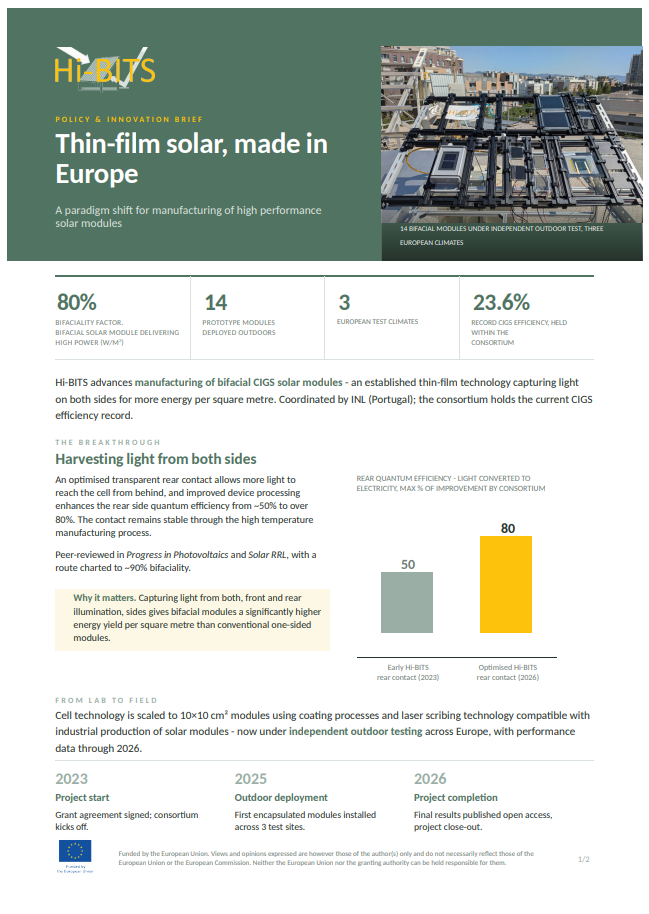
In regards to innovation and policy, Hi-BITS work contributes to an increase in sustainability and reduction of EU dependency in solar energy. Moreover, the project aligns with relevant policy frameworks: the EU Solar Energy Strategy / REPowerEU, the Net-Zero Industry Act, the Critical Raw Materials Act, and the European Green Deal. Other key outcomes include the outdoor deployment of 14 prototype modules, tested under 3 European climates, as well as 23.6% CIGS efficiency record achieved by the consortium.
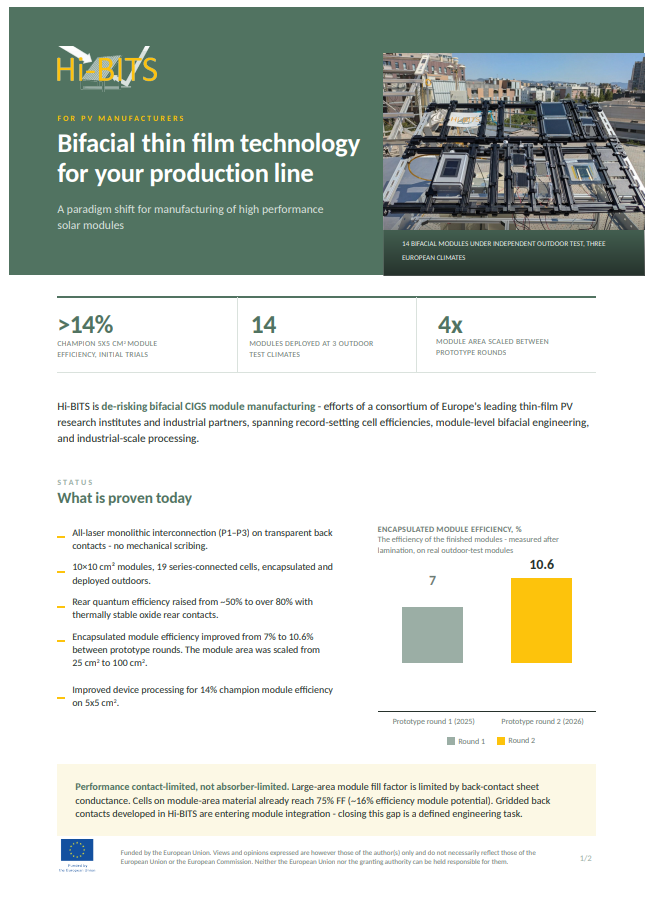
Within the PV industry landscape, Hi-BITS is de-risking bifacial CIGS module manufacturing. Among relevant outcomes, the consortium was able to surpass 14% module efficiency with a champion module in initial trials. As for product-line implications, these include: sputtered oxide rear contacts and laser patterning run on standard thin-film line equipment, machine Learning-based inline quality control flags irregularities during fabrication, Module FF is contact-limited, not absorber-limited, and All-laser P1–P3 patterning reduces dead-area losses.
Currently, IP and licensing discussions are available by contacting INL’s technology transfer office at innovation@inl.int. Additionally, all project publications are available with open access at zenodo.org/communities/hi-bits.
For deeper insights read the full factsheets: