
New publication: Improving VOC in wide bandgap (Ag,Cu) (In,Ga)Se2 solar cells for voltage-matched ACIGS/Si tandem modules
As the project's closure draws near, it is with great pride that the Hi-BITS consortium announces the release of a new publication in Solar Energy Materials and Solar Cells.
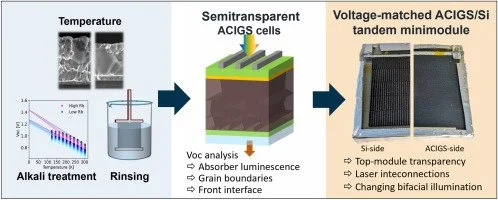
The publication “Improving VOC in wide bandgap (Ag,Cu) (In,Ga)Se2 solar cells for voltage-matched ACIGS/Si tandem modules” tackles one of the key limitations holding back wide-bandgap ACIGS absorbers from reaching their full potential in tandem solar cells: open-circuit voltage (VOC) deficit. The study investigates how growth temperature, surface cleaning methods, and a rubidium fluoride treatment influence voltage output, and translates these insights into a working tandem device.
🔗 Read the full publication: https://doi.org/10.1016/j.solmat.2026.114335
Key Findings on VOC Losses
The researchers' assessment led to several important conclusions:
Growing the material below 415°C creates rough films, copper shortages at the back contact, and electrical defects — all detrimental to performance. Higher growth temperatures produce better film quality and voltage output.
Rinsing with ammonia reduces voltage output, particularly at low rubidium doses, while rinsing with plain deionized water better preserves voltage and also boosts short-circuit current.
Using a photoluminescence-based technique (PLQY), the team was able to separate voltage losses originating in the bulk material from those occurring at surfaces and interfaces — a distinction that is difficult to make once a full solar cell is assembled.
The main driver of voltage loss is non-radiative recombination (energy dissipated as heat rather than light), rather than the material's internal composition gradient (Ga grading), which was found to offer less benefit than expected.
From Insights to Demonstration
Building on these findings, the authors present the first experimental demonstration of a voltage- and area-matched two-terminal bifacial ACIGS/Si tandem module, implementing a fully laser-interconnected top ACIGS submodule. Voltage matching was achieved at 10% rear illumination, with power density continuing to increase linearly beyond the matching condition — highlighting an advantage of this circuitry-2T approach over the current-matching constraints typical of series-connected tandems.
Open Access Publication
In line with open science practices, the publication is openly available, enabling reproducibility and further exploration by the research community.
🔗 Access the article: https://zenodo.org/records/22281895