
New Publication: “Titanium-Doped In2O3: A High-Mobility, Thermally Stable Back Contact for Bifacial Chalcopyrite Solar Cells”
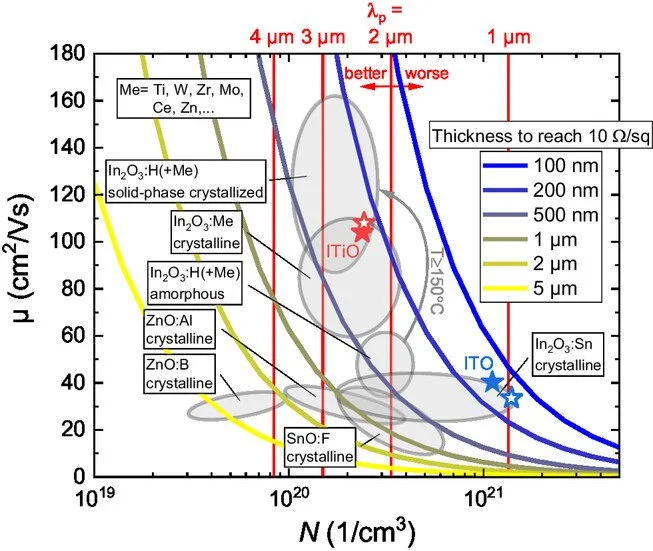
The Hi-BITS consortium is proud to announce a new publication, published in Solar RRL, presents a direct comparison of titanium-doped indium oxide (In₂O₃:Ti, or ITiO) and the widely used tin-doped indium oxide (In₂O₃:Sn, ITO) as transparent back contacts for bifacial (Ag,Cu)(In,Ga)Se₂ (ACIGS) solar cells.
Conventional CIGS devices rely on opaque molybdenum back contacts, which preclude bifacial operation and limit design flexibility. This study investigates whether ITiO can satisfy the electrical, optical, and thermal stability requirements for integration into module-compatible bifacial ACIGS devices, and demonstrates that it does so with notable advantages over ITO.
🔗 Read the full publication: https://doi.org/10.1002/solr.70291
Why Transparent Back Contacts Matter
For bifacial thin-film solar cells, the back contact must be both electrically conductive and optically transparent to near-infrared light. The paper evaluates ITiO against ITO with respect to:
Carrier mobility and free charge carrier absorption in the near-infrared range
Electrical and optical stability under high-temperature ACIGS absorber deposition
Sheet resistance compatibility with monolithic module integration (≤10 Ω/sq)
Solar cell performance under both front and rear illumination
Implications for Next-Generation Device Architectures
These findings are directly relevant to the development of bifacial ACIGS modules, photon-recycling devices, and multijunction tandem configurations, all of which stand to benefit from a thermally stable, NIR-transparent back electrode. By rigorously evaluating both material properties and device integration, this work provides a clear pathway for replacing ITO in advanced thin-film PV architectures.
Open Access Publication
The article is published open access in Solar RRL (Wiley), freely available via the DOI above.