
Making Innovation Scalable: An Interview with Andreas Zimmermann
The innovative solar technology developed within Hi-BITS targets three application areas: building-integrated photovoltaics, vehicle-integrated photovoltaics, and agri-photovoltaics.
To advance this goal, Work Package 5 (WP5), Application Prototypes and Road Map for Upscaling, is pivotal as it focuses on developing fully functional prototype modules to be tested under real-world conditions.
In this interview, Andreas Zimmermann, CEO of Sunplugged and WP5 leader, discusses the technical promises and challenges encountered during prototype development.
Prototyping the future of CIGS Technology

Andreas Zimmermann, CEO of Sunplugged and Hi-BITS WP5 leader
Q: What is the main role of WP5 within the Hi-BITS project, and how does it link the lab-scale innovations to real-world applications?
Andreas: Sunplugged leads WP5. While our scientific partners — supported by experts like Roland Scheer — achieve breakthroughs at the cell and module level, WP5 is where we translate these advances into application prototypes. Beyond leading WP5, Sunplugged is also deeply involved in WP3 and WP4, ensuring that innovations such as silver-alloyed absorbers and advanced light management are designed from the start with industrial scalability and real-world durability in mind.
Q: Which of the prototype applications currently under development do you see as most promising — and why?
Andreas: For Sunplugged, the prototypes with integrated back-reflectors are particularly exciting, as this technology has the potential to significantly boost efficiency by optimizing light harvesting within the thin-film stack. We also see strong exploitation potential in the semi-transparent and bifacial modules, even if they are not Sunplugged's primary focus, as they represent the next generation of flexible CIGS products we aim to integrate into our made-to-measure production line.
The Road to Stable Modules: Key Challenges
Q: What are the key technical or practical challenges you face in upscaling and preparing these prototypes for field testing?
Andreas: The transition from a high-efficiency cell to a stable module is where the real work happens. One of our main focuses in WP4 is the development of transparent protective layers deposited directly onto the CIGS cells. The challenge lies in creating a barrier that is robust enough to replace heavy glass encapsulation while remaining thin and flexible. Additionally, maintaining the benefits of silver alloying across larger areas requires extremely precise process control during the upscaling phase to avoid efficiency losses.
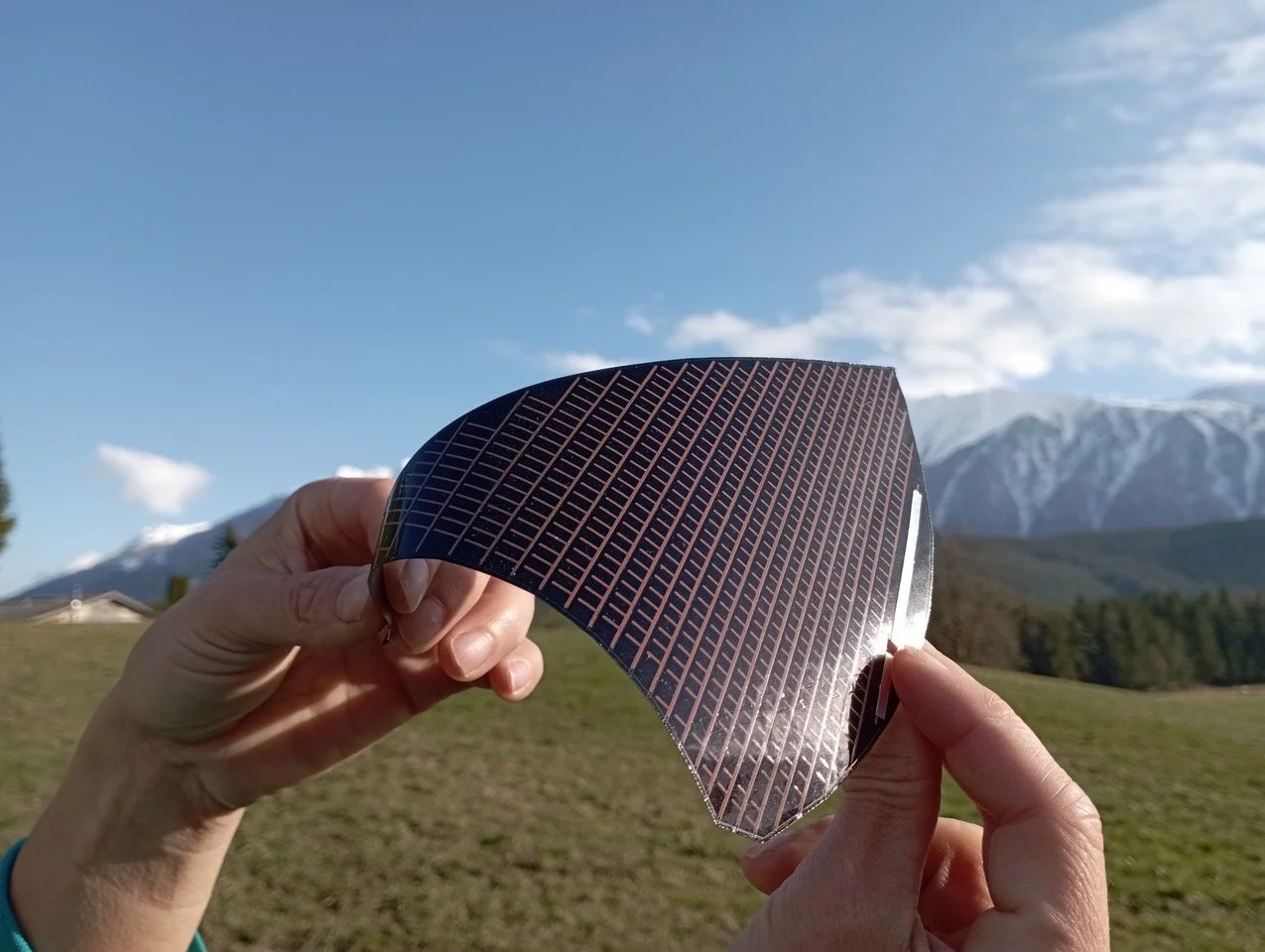
Flexible CIGS Sheet
Looking Ahead
The prototypes and industrial scalability roadmap developed under WP5 provide the foundation for WP6 and WP7. The fully functionalised and encapsulated prototype modules are currently undergoing real-world testing across multiple European sites with diverse climatic conditions, enabling a comprehensive assessment of their performance.