
New Publication: “Bifacial (Ag,Cu)(In,Ga)Se2 Mini-Modules With Transparent ITiO Back Contacts: Performance Analysis and Effects of RbF Treatment”
The Hi-BITS consortium has recently released a new publication in the journal Solar RRL.
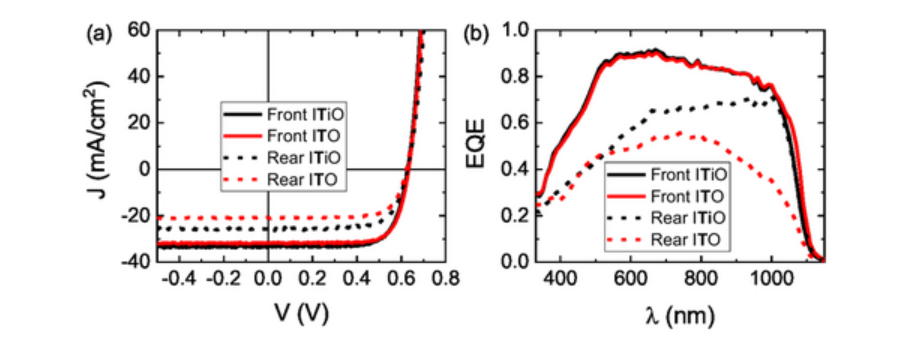
The publication "Bifacial (Ag,Cu)(In,Ga)Se2 Mini-Modules With Transparent ITiO Back Contacts: Performance Analysis and Effects of RbF Treatment" addresses a key step toward bifacial thin-film photovoltaics: replacing the conventional opaque back contact of (Ag,Cu)(In,Ga)Se2 (ACIGS) devices with a transparent one, so that light can be harvested from both sides. The study presents bifacial ACIGS mini-module prototypes built on a high-mobility ITiO transparent back contact, analyses their performance and the effects of a rubidium fluoride treatment, and identifies the main losses between cell and module level.
🔗 Read the full publication: https://onlinelibrary.wiley.com/doi/10.1002/solr.70501
Key Findings on Module Performance
The researchers' assessment led to several important conclusions:
A champion 7.14 cm² aperture-area mini-module reached a front-side efficiency of 13.5% (14.3% as initially measured, before sample shipment), without the use of anti-reflection coatings.
The excellent optical transparency of the ITiO back contact enabled a bifaciality factor of 76%, meaning the module retains about three quarters of its front-side efficiency when illuminated from the rear.
A rubidium fluoride post-deposition treatment was applied to boost open-circuit voltage. It initially introduced a barrier to charge-carrier transport that reduced the fill factor, but this penalty was completely eliminated by a heat-light soaking treatment.
The main cell-to-module efficiency loss, about 2% points, was attributed to a reduction in fill factor from roughly 75% to 67%. Reference cells from the same absorber depositions, using an ITO back contact and a thinner front electrode, reached efficiencies of up to 18% without anti-reflection coatings.
From Cells to Modules
Beyond device performance, the authors demonstrate an all-laser-scribed monolithic series interconnection for the bifacial mini-modules. They also present an alternative approach in which the P3 isolation line is defined by a lithography-based process. Both are relevant for translating lab-scale bifacial ACIGS cells into scalable module designs.
Open Access Publication
In line with open science practices, the publication is openly available, enabling reproducibility and further exploration by the research community.
🔗 Access the article: https://zenodo.org/communities/hi-bits/records?q=&l=list&p=1&s=10&sort=newest